Jazz Since the 1940s — A Visual Guide to Where It All Went
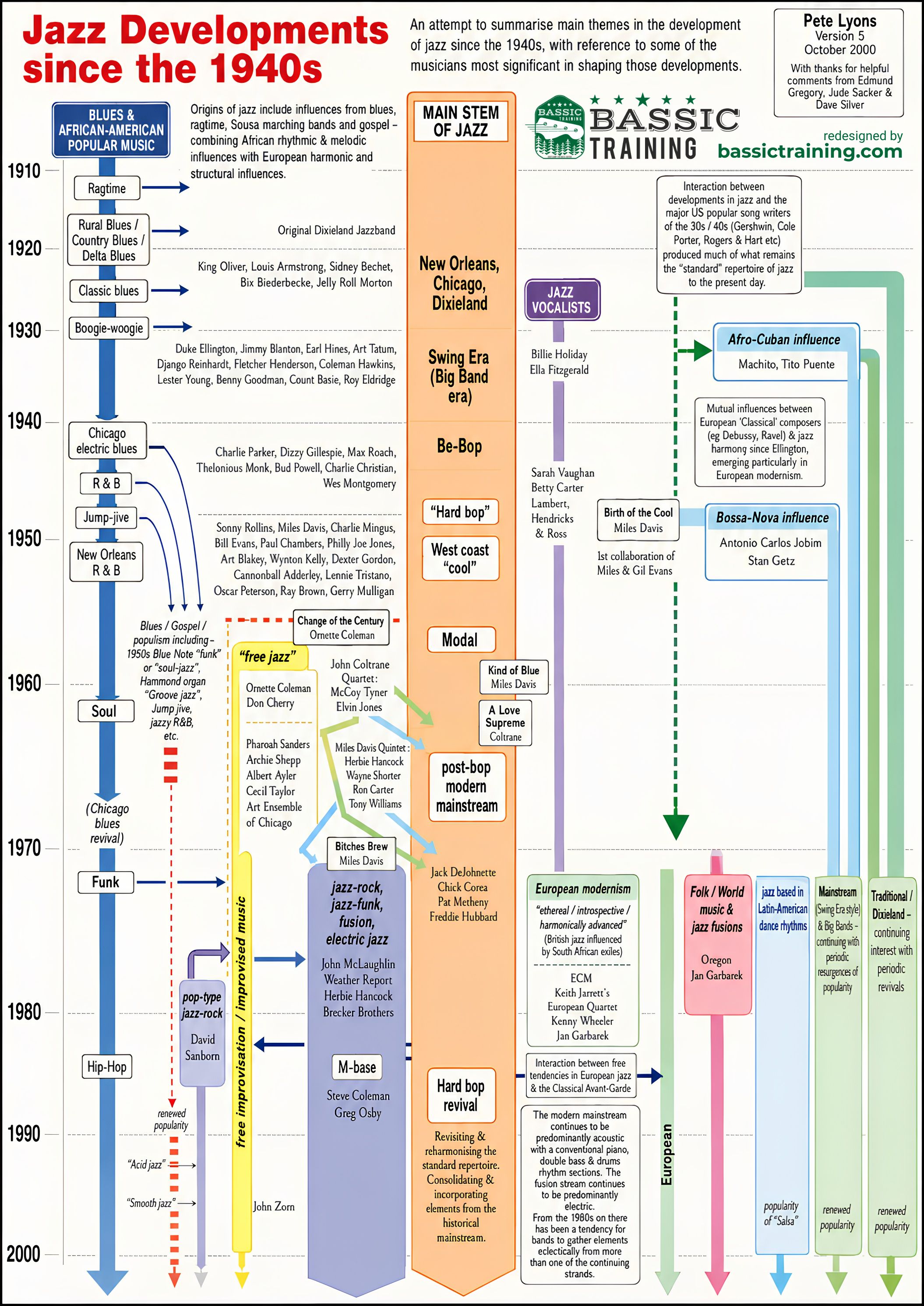
Jazz doesn’t have a single story — it has several running simultaneously, branching, colliding, and feeding back into each other across eight decades. This infographic originally by Pete Lyons which I have just redesigned, maps those threads from the 1940s to 2000, tracing how blues and African-American popular music splintered into some of the most adventurous and influential sounds ever committed to tape. Take a moment with it before reading on — the picture does most of the talking.
The Main Stem — From Swing to Modern Mainstream
The central thread runs from New Orleans and Chicago Dixieland through the Swing and Big Band era of the 1930s, before bebop cracked everything open in the 1940s. Charlie Parker, Dizzy Gillespie, Thelonious Monk and Miles Davis shifted jazz from a popular dance music to a musician’s music — faster, harmonically denser, and demanding close listening. Hard bop followed in the 1950s, modal jazz in the 1960s (Miles Davis’s Kind of Blue being the landmark), and by the 1970s a post-bop modern mainstream had settled in — acoustic, sophisticated, and continuing strongly into the present.
The Free Jazz Break
Running alongside the main stem from the late 1950s is the free jazz strand — Ornette Coleman’s “Change of the Century” marking the rupture point. This stream prioritised collective improvisation and emotional intensity over harmonic structure, with John Coltrane’s quartet, Pharoah Sanders, and Cecil Taylor pushing further into avant-garde territory through the 1960s. It remained a parallel current rather than a mainstream one, but its influence on every subsequent form of adventurous music is hard to overstate.
Fusion — When Jazz Plugged In
Miles Davis’s Bitches Brew in 1970 is the infographic’s clearest fork point. Jazz-rock, jazz-funk, and electric jazz emerged from that collision, with Herbie Hancock, Weather Report, John McLaughlin, and the Brecker Brothers carrying the current through the 1970s. By the 1980s this had splintered further into pop-influenced jazz-rock and the more cerebral M-Base movement of Steve Coleman and Greg Osby. The fusion stream has remained predominantly electric ever since.
The International Currents
The diagram’s right-hand side tells a quieter but equally important story. Afro-Cuban rhythms brought Machito and Tito Puente into the jazz conversation. Bossa nova arrived from Brazil via Jobim and Stan Getz in the 1950s and early 1960s. European classical composers and jazz harmony cross-pollinated from Ellington onward, eventually producing a distinctly European modernism — introspective, harmonically advanced, represented by the ECM label, Keith Jarrett, and Jan Garbarek. Folk and world music fusions added further colour, with salsa rising in Latin-American dance rhythm traditions through the 1980s and beyond.
What It Means for Bass Players
Every one of these streams left a mark on how the bass is played. Walking bass lines from the swing era, the melodic freedom of modal playing, the groove-first approach of funk and fusion, the lyrical restraint of bossa nova — understanding where these sounds came from is understanding why the bass guitar plays the role it does in virtually every style of modern music. The diagram above is, among other things, a map of your instrument’s evolution.